UK VAT Refund Opportunity: HMRC Reopens Rejected VAT Group Claims Since 2021
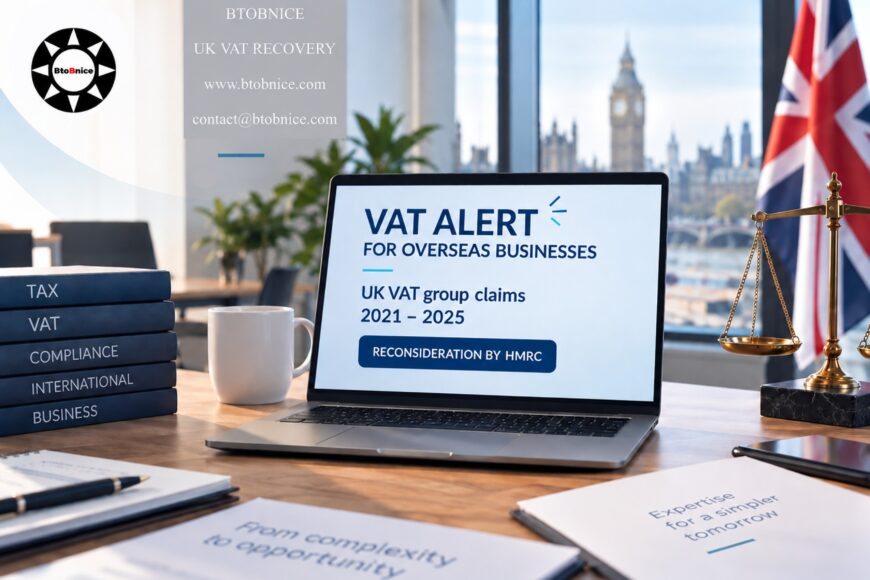
VAT ALERT: HMRC has changed the UK VAT refund rules for non-UK businesses in VAT groups. Eligible businesses can now ask HMRC to reconsider certain UK VAT refund claims rejected since 1 January 2021. Requests must be submitted by 31 August 2027.
HMRC announces a major change to UK VAT refunds for overseas VAT group members
On 8 September 2026, HM Revenue & Customs (HMRC) published Revenue & Customs Brief 8 (2026), “UK VAT refunds for non-UK businesses in a VAT group”, introducing an important change to the way non-UK businesses that are members of a VAT group claim refunds of UK VAT.
Under the revised policy, each non-UK VAT group member must submit its own UK VAT refund claim for the VAT it has incurred. A VAT group’s representative member may now claim only the UK VAT that it has itself incurred.
More importantly, HMRC has introduced an exceptional opportunity to revisit the past: businesses whose UK VAT refund claims were rejected for VAT incurred from 1 January 2021 because the claim had not been submitted by the VAT group’s representative member may now ask HMRC to reconsider those claims.
This change creates a significant UK VAT recovery opportunity for non-UK businesses that have been unable to recover UK VAT since Brexit because of their VAT group structure. Requests for reconsideration must be submitted to HMRC by 31 August 2027.
Why has HMRC changed the UK VAT group refund rules?
Before 1 January 2021, HMRC applied different rules to overseas businesses depending on whether they were established inside or outside the European Union.
Businesses established outside the EU and belonging to a VAT group were required to submit UK VAT refund claims through the group’s representative member, even where that entity had not itself incurred the UK VAT.
For EU businesses, the position was different: in certain circumstances, an individual member of an EU VAT group could submit a UK VAT claim in its own name.
Following the UK’s withdrawal from the European Union, HMRC applied a single approach from 1 January 2021: all non-UK businesses belonging to a VAT group were required to submit their UK VAT refund claims through their representative member.
This produced an unintended result.
An EU company that had itself incurred UK VAT could no longer submit the claim in its own name. In certain situations, the VAT could become effectively unrecoverable — notably where the VAT group’s representative member was itself registered for VAT in the UK and therefore unable to use the overseas VAT refund scheme.
HMRC now expressly acknowledges that this was an “unintended consequence of the UK’s exit from the EU”. Revenue & Customs Brief 8 (2026) is intended to restore the previous position and ensure that eligible non-UK businesses can recover UK VAT under the same approach.
New rule from 8 September 2026: each VAT group member claims its own UK VAT
The new HMRC position is straightforward: the business that incurred the UK VAT must submit the UK VAT refund claim.
Accordingly, a non-UK business that belongs to a VAT group must now submit its own claim for UK VAT that it has incurred, rather than submitting that VAT through the group’s representative member.
Conversely, the representative member may claim only VAT that it has itself incurred. HMRC will no longer accept a claim from the representative member for VAT incurred by another member, subject to the transitional rules described below.
The revised rule applies to non-UK businesses generally, rather than only EU businesses, and therefore creates a uniform approach for overseas VAT group members.
HMRC simultaneously updated VAT Notice 723A – Refunds of UK VAT for non-UK businesses on 8 September 2026 to reflect the new policy.
Rejected UK VAT refund claims since 2021 can now be reconsidered
The most significant aspect of Revenue & Customs Brief 8 (2026) is its retrospective effect.
HMRC will reconsider claims relating to UK VAT incurred from 1 January 2021 where the claim was rejected because it was submitted by the individual VAT group member rather than by the group’s representative member.
This opportunity is available provided that the same VAT was not subsequently included in a claim submitted by the representative member.
This may therefore concern businesses whose UK VAT refund claims were rejected during the 2021 to 2025 prescribed years, as well as other affected claims relating to VAT incurred from 1 January 2021.
It may be particularly relevant where:
- an individual EU or non-EU VAT group member submitted a UK VAT refund claim in its own name and HMRC rejected it because the claim should, under HMRC’s former policy, have been submitted by the representative member;
- the representative member was UK VAT registered, preventing the VAT group member that actually incurred the VAT from obtaining a refund under the overseas VAT refund scheme;
- a business accepted an HMRC rejection following Brexit and did not pursue a further UK VAT appeal or challenge because HMRC’s published policy required the representative member to make the claim.
For affected businesses, VAT previously considered lost may therefore now be recoverable.
How to reopen a UK VAT claim rejected by HMRC
HMRC has established a specific procedure for these historical claims.
The business must ask HMRC’s Overseas Repayments Unit to reconsider the rejected claim and use the subject line specified by HMRC:
“Reconsideration of a previously refused VAT group claim”
The request must identify the business and provide the Overseas Repayments Unit reference and claim number, the relevant claim period and value, the date of HMRC’s decision letter, the full names of all VAT group members during the claim period and confirmation that the VAT was not included in a subsequent claim by the representative member.
Deadline: 31 August 2027
Businesses wishing to benefit from this exceptional reconsideration procedure must act by 31 August 2027.
HMRC expressly states that requests received after that date will not be considered.
Companies that have received UK VAT refund rejection decisions since 2021 should therefore review their historical claims now rather than waiting until the deadline approaches.
Special transitional rules for the 2025–2026 UK VAT refund year
HMRC has introduced a transitional arrangement for the current year covering 1 July 2025 to 30 June 2026.
For this period only, HMRC will accept a UK VAT refund claim from either:
- the individual VAT group member that incurred the VAT; or
- the VAT group’s representative member.
The normal deadline for claims covering the 2025–2026 prescribed year remains 31 December 2026.
Businesses should therefore distinguish carefully between:
- historical rejected claims, for which the exceptional reconsideration deadline is 31 August 2027, and
- new claims for VAT incurred between 1 July 2025 and 30 June 2026, which must still be submitted by 31 December 2026.
For subsequent prescribed years, the new principle applies: each overseas VAT group member must claim the UK VAT that it has itself incurred.
A wider review of UK VAT grouping principles?
Revenue & Customs Brief 8 (2026) does not state that the change results from a particular court judgment. HMRC expressly presents it as the correction of an unintended post-Brexit consequence.
It nevertheless comes against a wider background of recent developments concerning the territorial and cross-border application of UK VAT grouping rules.
In Barclays Services Corporation and Barclays Execution Services Limited v HMRC [2026] UKUT 211 (TCC), the Upper Tribunal considered important questions concerning VAT grouping, including the existence of a UK fixed establishment, the territorial scope of the UK VAT grouping provisions and HMRC’s ability to refuse VAT group membership for the protection of the revenue. The judgment was issued on 8 June 2026.
HMRC has also recently revisited other aspects of the interaction between VAT groups and cross-border transactions, including its interpretation of the Skandia principles.
Revenue & Customs Brief 8 (2026) should not therefore be presented as a direct consequence of these cases. However, it forms part of a broader period of significant scrutiny and development of the UK VAT grouping rules, both domestically and in their application to overseas businesses.
BTOBNICE can assist with the recovery of previously rejected UK VAT
BTOBNICE assists EU and non-EU businesses with UK VAT recovery and UK VAT refund claims.
Following HMRC’s announcement of 8 September 2026, our VAT experts can review rejected claims from both EU and non-EU VAT group members to determine whether they qualify for reconsideration under Revenue & Customs Brief 8 (2026).
In particular, BTOBNICE can assist businesses and VAT groups with:
- reviewing UK VAT refund claims rejected by HMRC since 1 January 2021;
- identifying rejection decisions affected by HMRC’s former representative-member policy;
- verifying that the VAT concerned was not subsequently recovered through another VAT group claim;
- preparing and submitting requests for reconsideration of previously refused VAT group claims to HMRC as agent;
- reviewing the appropriate claim procedure for open and non-expired UK VAT refund periods;
- preparing current and future UK VAT claims for EU and non-EU VAT group members;
- managing correspondence and follow-up with HMRC’s Overseas Repayments Unit.
BTOBNICE also assists foreign businesses that are not members of VAT groups with their UK VAT recovery, from the review of eligible invoices through to the submission and follow-up of the refund claim with HMRC.
Has your UK VAT refund claim been rejected since 2021 because your company belongs to a VAT group?
Contact our VAT experts to assess whether your previously rejected UK VAT can now be recovered: contact@btobnice.com
Source : HMRC Policy Paper – 08 September 2026
FAQ – UK VAT Refunds for Non-UK VAT Group Members
Can an EU company belonging to a VAT group submit its own UK VAT refund claim?
Yes. Under HMRC’s revised policy announced on 8 September 2026, a non-UK VAT group member must submit its own claim for UK VAT that it has incurred, provided that it meets the conditions of the overseas VAT refund scheme.
Does the new UK VAT refund rule apply only to EU VAT groups?
No. HMRC’s new rule applies to non-UK businesses that are members of VAT groups. This includes eligible businesses established both within and outside the EU. Each member must claim separately for the UK VAT it has incurred.
Can a UK VAT refund rejected after Brexit now be recovered?
Potentially, yes. HMRC will reconsider claims for VAT incurred from 1 January 2021 that were rejected because the representative member of the VAT group did not submit the claim, provided the VAT was not subsequently included in a claim made by the representative member.
What is the deadline for asking HMRC to reconsider a rejected VAT group claim?
The request must reach HMRC by 31 August 2027. HMRC states that requests received after this date will not be considered.
What is the UK VAT refund deadline for the 2025–2026 prescribed year?
For VAT incurred between 1 July 2025 and 30 June 2026, the claim deadline remains 31 December 2026. As a transitional measure, HMRC will accept a claim for this prescribed year from either the individual VAT group member that incurred the VAT or the group’s representative member.
Can the representative member still submit UK VAT claims for the whole VAT group?
Generally, no under the new policy. Going forward, the representative member may claim only the UK VAT that it has itself incurred. The temporary exception applies to the 1 July 2025 to 30 June 2026 prescribed year.
Can BTOBNICE act as agent for the reconsideration of a rejected UK VAT claim?
Yes. BTOBNICE can review the original claim and HMRC rejection, assess whether the claim falls within the scope of Revenue & Customs Brief 8 (2026), prepare the reconsideration request and manage the correspondence with HMRC on the client’s behalf.