

Yacht Repairs in the EU: When Can Import VAT and Customs Duties Be Avoided? – EU Court Ruling T-383/25
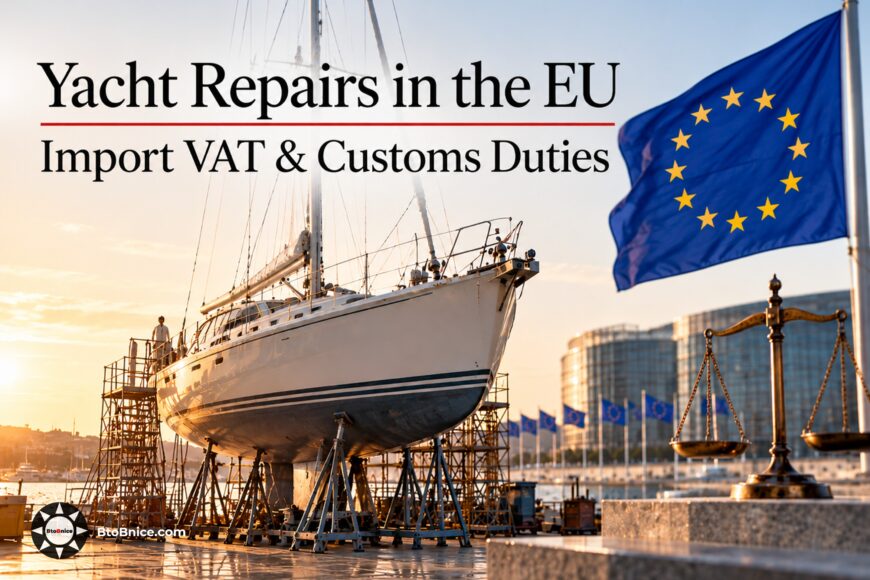
On 21 October 2026, the General Court of the European Union delivered an important judgment clarifying the VAT and customs treatment of non-EU sailing boats temporarily brought into the EU for maintenance and repair.
In Case T-383/25 (Hauptzollamt A v Segelbootwartung), the Court ruled that an irregular introduction of a sailing boat into the EU does not automatically trigger import VAT, and that repair work does not necessarily prevent the extinction of a customs debt following re-exportation.
Although the case concerned a sailing boat, the judgment has broader implications for the yachting industry, particularly yacht owners, yacht managers, brokers and shipyards dealing with non-EU pleasure craft.
Background: A Swiss Sailing Boat Repaired in Germany
The dispute arose when a Swiss resident transported his Swiss-registered sailing boat into Germany on a trailer in March 2017, without completing the required customs formalities.
The boat was brought exclusively for maintenance and repair work, including engine servicing and repairs to its centreboard and fuel system.
Following a customs inspection, the German customs authorities assessed import VAT and customs duties, arguing that the boat had entered the EU without proper customs clearance.
The owner subsequently had the repairs completed and re-exported the sailing boat to Switzerland, without ever using it for navigation within the EU.
He challenged the tax assessment, arguing that the boat had not been used in the EU and that its re-exportation should prevent the collection of import VAT and customs duties.
The dispute ultimately led the German Federal Fiscal Court to request a preliminary ruling from the General Court of the European Union.
The EU Court’s Judgment: Two Important Clarifications
Import VAT: No Automatic Taxation Without Actual Use in the EU
The General Court confirmed that a breach of customs formalities does not automatically make import VAT payable.
Import VAT is fundamentally a tax on consumption. Therefore, the mere physical introduction of a non-EU means of transport into the EU does not necessarily establish that it has entered the EU’s economic network for VAT purposes.
Where objective and verifiable evidence demonstrates that the means of transport:
- Was not intended to be used within the EU;
- Was re-exported outside the EU; and
- Was not actually used within the EU before re-exportation;
the presumption of entry into the EU’s economic network may be rebutted, meaning that no import VAT is payable.
Importantly, maintenance and repair work do not, in themselves, constitute actual use of a sailing boat as a means of transport.
The Court also distinguished import VAT on the boat from any VAT applicable to the repair services themselves, which remain separate transactions.
Customs Duties: Repairs Do Not Necessarily Prevent Extinction of the Customs Debt
The Court also clarified the application of Article 124(1)(k) of the Union Customs Code (UCC).
Under this provision, a customs debt arising from non-compliance may be extinguished where the goods have not been used or consumed, have left the EU customs territory and no deception has been attempted.
The Court ruled that maintenance and repair work does not constitute prohibited use for this purpose where those operations could have been authorised under the inward processing procedure.
Inward processing allows non-EU goods, including pleasure craft, to undergo authorised repairs or processing within the EU without import duties becoming payable, subject to the applicable conditions.
Crucially, the absence of prior authorisation does not automatically prevent the application of Article 124(1)(k).
However, the competent national court must verify whether the repairs and the circumstances of the case satisfied the conditions that would have allowed inward processing authorisation, including the relevant requirements for retrospective authorisation.
THE GENERAL COURT (Second Chamber, sitting with five Judges)
hereby rules:
1. Article 2(1)(d) and Articles 30, 70 and 71 of Council Directive 2006/112/EC of 28 November 2006 on the common system of value added tax
must be interpreted as meaning that the unauthorised introduction of a means of transport from a third country into the customs territory of the European Union does not constitute an importation of goods subject to value added tax (VAT), where it is established, on the basis of objective and verifiable evidence, that such a means of transport was not intended for use within that territory and that it was re-exported without having been actually used within that territory.
2. Article 124(1)(k) of Regulation (EU) No 952/2013 of the European Parliament and of the Council of 9 October 2013 laying down the Union Customs Code
must be interpreted as meaning that the fact that goods have, prior to their re-export, undergone maintenance and repair work within the customs territory of the Union does not constitute use of those goods within the meaning of that provision, where such work could have been authorised under the inward processing procedure.
Procedural status: The judgment was delivered following a request for a preliminary ruling from the German Federal Fiscal Court (Bundesfinanzhof). While the General Court has clarified the applicable EU VAT and customs rules, the German court must still determine the outcome of the national dispute in light of those findings. The judgment also remains subject to the exceptional EU judicial review mechanism.
Practical Implications for the Yachting Industry
This judgment provides welcome clarification and greater legal flexibility for non-EU yacht owners and yachting professionals.
- Administrative customs error does not necessarily result in definitive import taxation.
Where a yacht has been brought into the EU exclusively for repairs and subsequently re-exported without being used for navigation, there may be grounds to challenge import VAT and customs duties assessed following a customs irregularity.
However, the absence of actual use, the purpose of the visit and the re-exportation must be supported by reliable documentation.
2. Purpose of a yacht’s entry into the EU determines the appropriate customs procedure.
Two regimes are particularly relevant:
- Temporary Admission (TA): Generally allows eligible non-EU pleasure craft to navigate within the EU under relief from import VAT and customs duties, normally for up to 18 months, subject to specific conditions.
- Inward Processing (IP): Allows non-EU yachts to undergo authorised repairs, refits or other processing operations without import duties becoming payable and with the corresponding import VAT treatment, subject to the applicable rules.
Routine maintenance may be permitted under Temporary Admission, while more substantial repair or refit operations may require Inward Processing.
3. Customs planning remains essential.
Before bringing a non-EU yacht into the EU, owners and yacht managers should identify:
- The purpose of entry: navigation, maintenance, repair or refit;
- The expected duration of the yacht’s stay;
- The appropriate customs procedure and applicable eligibility conditions;
- The required customs declarations and authorisations;
- The documentation needed to demonstrate compliance and eventual re-exportation.
Evidence may include yacht registration and ownership documents, repair contracts and invoices, customs records, movement logs and proof of exit from the EU.
The key takeaway: The judgment offers protection against disproportionate tax consequences in certain cases of customs non-compliance. It does not, however, remove the obligation to follow the appropriate customs procedures or eliminate the risk of customs penalties.
How BtoBnice Can Help
At BtoBnice, we support yacht-owning companies, charter operators, yacht managers and other yachting professionals with tailored EU VAT and customs advisory services.
Our expertise includes:
- Yacht import VAT and customs advisory;
- Temporary Admission and Inward Processing reviews;
- Cross-border VAT compliance and VAT recovery;
- Yacht charter VAT compliance and tax optimisation;
- Yacht flag registration and ongoing compliance support.
Whether you are planning a yacht’s entry into the EU, arranging maintenance or refit works, or reviewing an existing customs position, BtoBnice can help you identify the appropriate tax treatment, manage compliance obligations and optimise your VAT and customs costs.
Contact BtoBnice to discuss your yachting VAT and customs requirements: contact@btobnice.com